MarkMe: QR-Based Lost & Found Service
I shaped the UX writing, localization, and conversational design for Markme—a QR-based lost-and-found service powered entirely through WhatsApp automation. After encountering the product during a usability test, I identified gaps in clarity, tone, and navigation and initiated collaboration with the team. I rewrote inconsistent Hebrew flows, built a structured English version, refined packaging design, and contributed UX recommendations that strengthened user guidance and data collection across the system.
Role
UX Writer & Localization Specialist
Industry
Consumer Technology
Product Context
Markme is a QR-based lost-and-found service that connects item owners and finders through an anonymous WhatsApp chatbot. When a QR sticker attached to a personal item is scanned, the finder is automatically routed into a messaging flow that facilitates secure communication between both parties. Because the entire experience—from activation to recovery—is managed through chat, language is not just supporting content; it is the product interface.
This structure significantly increases the importance of clarity and accessibility. Lost items are frequently misplaced during travel or in public spaces, where the finder may not share the owner’s language. In a system dependent on strangers successfully navigating an automated chat flow, linguistic barriers directly reduce the product’s effectiveness and recovery rate.
Product Gaps Identified
Conversational Flow Friction
The original Hebrew flow included unclear activation logic, inconsistent terminology, uneven tone, and insufficient guidance at key decision points. Because users rely entirely on text to understand what to do next, these gaps directly affected clarity, trust, and task completion.
Limited Accessibility and Market Reach
The product was available only in Hebrew, which limited both who could purchase it and who could successfully use it. Non-Hebrew-speaking customers were unlikely to buy a product they could not fully understand at the packaging or onboarding level. At the same time, if a non-Hebrew-speaking finder scanned a lost item, they would encounter a fully Hebrew chatbot flow—reducing the likelihood of successful engagement and recovery.
Because lost items frequently occur during travel or in multicultural environments, restricting the system to one language reduced both its market reach and its real-world effectiveness. This language limitation impacted conversion at the point of sale and recovery success after an item was lost.
Packaging and Value Communication Gaps
The packaging design did not clearly communicate what the product is, what value it brings, and key information about the product. Messaging lacked hierarchy and transparency, making it difficult for buyers to immediately understand the service.
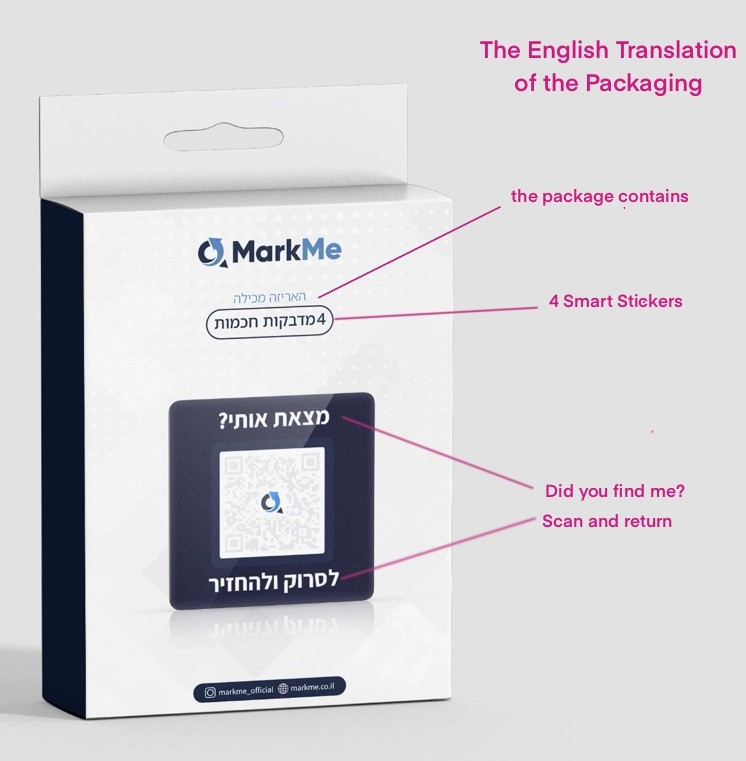
Retail feedback reinforced this issue: sales increased significantly when the product was accompanied by a nearby explanatory poster, suggesting that the packaging alone was not effectively communicating the value proposition. If additional signage is required to clarify the product, the packaging itself is not doing its job.
This lack of clarity extended beyond layout and hierarchy into broader brand positioning. Messaging across touch points—including the WhatsApp onboarding flow—relied on abstract phrases such as “Connecting people and things.” While conceptually accurate, this wording did not clearly anchor the product in its specific function: helping people recover lost belongings. The absence of precise, outcome-focused language diluted differentiation and weakened the product’s identity in both retail and digital contexts.
Missing Feedback Loops and Performance Tracking
The original flow did not consistently prompt users to confirm when an item had been successfully returned. As a result, the company lacked a reliable mechanism to measure return success rate—one of the product’s most critical KPIs.
Because Markme’s core value proposition is reuniting people with lost belongings, understanding how often recovery actually occurs is essential for product validation, marketing credibility, and iterative improvement. Without structured confirmation prompts built into the conversational flow, valuable behavioral data was being lost at the moment of resolution.
Strategic Interventions
Localization-Led Flow Refinement
While building the English version of the WhatsApp bot, I conducted a detailed review of the existing Hebrew conversational flows. As a non-native Hebrew speaker, translating the content required careful interpretation of activation logic, terminology, and sequencing. This process surfaced inconsistencies, unclear instructions, tone shifts, and missing guidance at key decision points.
Rather than translating the issues forward into English, I flagged and refined them at the structural level—standardizing terminology, clarifying next-step instructions, and strengthening confirmation states. In this way, localization became a mechanism for identifying and correcting underlying UX writing gaps in the original flow.
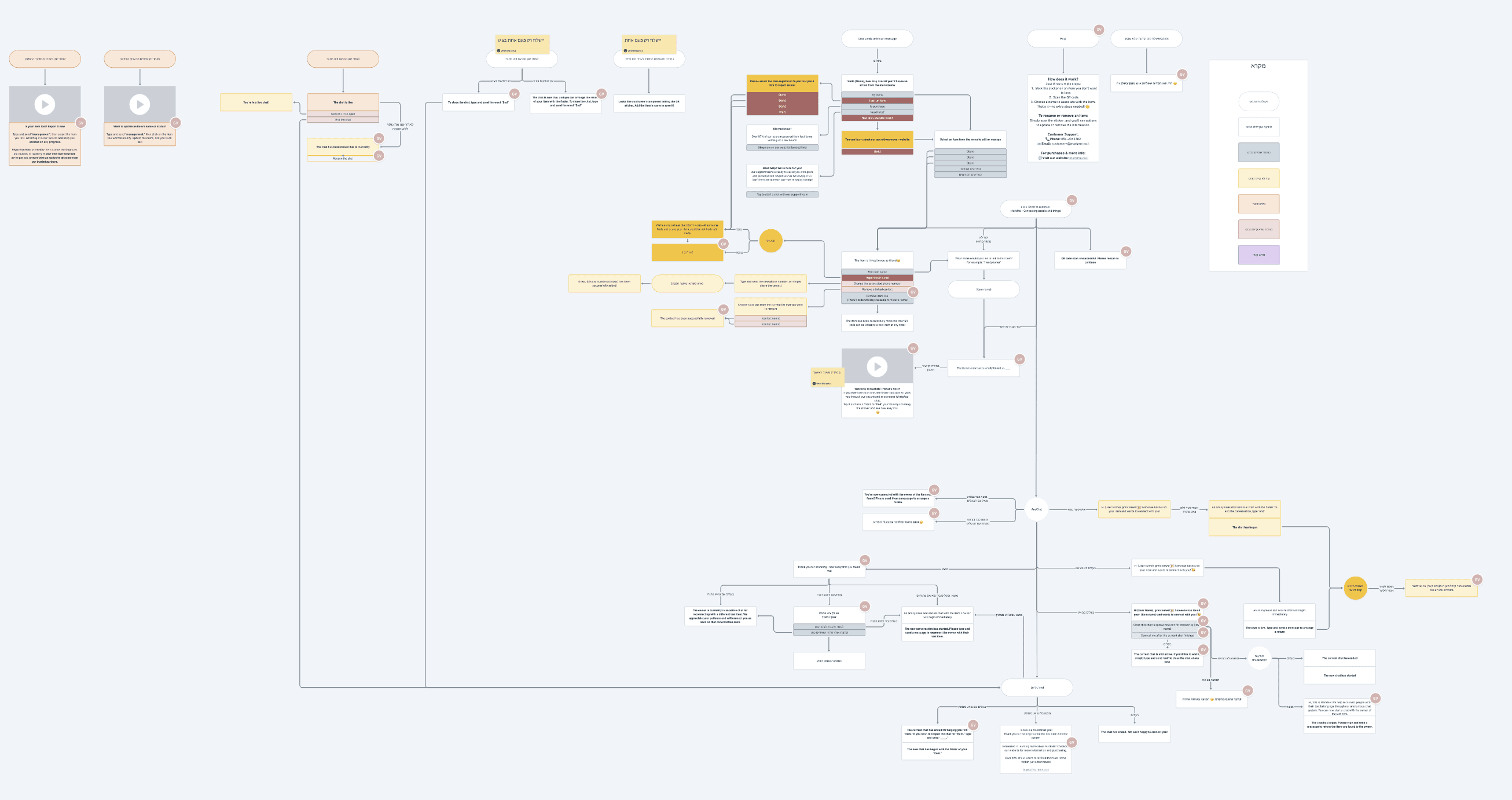
Note: Conversational flows and internal logic have been redacted due to NDA constraints. The blurred diagrams above represent partial flows shared with permission for portfolio purposes.
Multilingual Product Expansion
I developed a fully structured English version of the chatbot, ensuring that the flows were adapted—not directly translated—to match English conversational norms and usability expectations. In parallel, I provided suggested refinements to the Hebrew copy to improve clarity and professionalism. This dual-language improvement expands accessibility for both buyers and finders while increasing the product’s international viability.
Packaging and Positioning Refinement
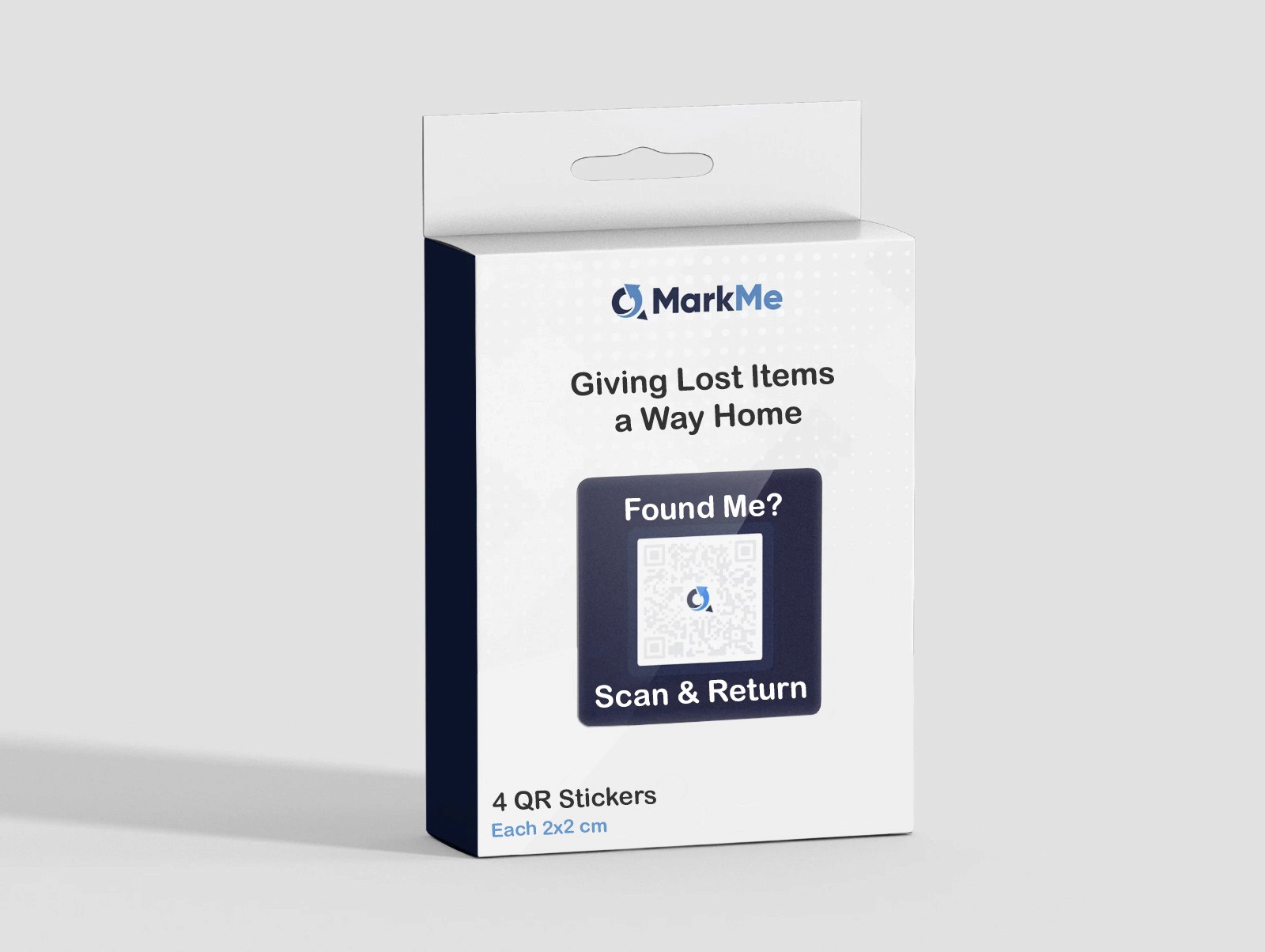
I provided UX recommendations to simplify packaging hierarchy and improve informational clarity at the point of sale. Messaging was reorganized to clearly communicate what the product is, how it works, and what is included in the packaging. I also proposed more specific, outcome-driven slogan alternatives to replace abstract phrasing, aligning brand messaging with the product’s core function: reuniting people with lost belongings.
KPI-Driven Flow Improvements
To support measurable product performance, I recommended introducing structured confirmation prompts when an item was successfully returned. These additions created a clearer feedback loop, enabling the company to track return success rate and better evaluate product effectiveness. By embedding data-capture moments directly into the conversational flow, the system became more aligned with long-term growth and optimization.
Outcomes and Product Impact
The UX refinements introduced through the localization process were implemented in the Hebrew conversational flow, resulting in clearer activation logic, more consistent terminology, and improved guidance across key interaction points. These adjustments strengthened usability within the live system and increased overall clarity and professionalism.
Packaging recommendations were also adopted, simplifying hierarchy and improving transparency around what the product is and how it works. Retail feedback had previously indicated that additional signage improved sales, reinforcing the importance of clearer value communication at the point of purchase.
Although the structured English version was completed, it was not ultimately launched due to startup resource constraints. However, the process established a documented framework for multilingual expansion and surfaced structural improvements that enhanced the core product experience.

