
Ascribe: AI-Powered Medical Documentation
I directed the UX research and UX writing that shaped Ascribe’s core experience—an AI system that helps nurses generate accurate, standardized notes from quick verbal, photographed, or typed inputs. I also independently wrote, produced, and developed our product video. Our team won Reichman University’s 2025 AI Product Sprint, and we were flown to New York to continue building the prototype at Wix, in collaboration with Base44 and Mount Sinai Hospital.
Role
UX Writer, UX researcher, AI Video Creator
Industry
Healthcare Technology
See Prototype
Project Overview
Ascribe was built during a four-week AI Product Sprint focused on solving real problems facing frontline medical staff. Our goal was to reduce documentation burden for nurses by enabling fast, accurate clinical note generation using AI. This project combined rapid UX research, iterative prototyping, and close collaboration with industry partners.
The Problem
Through interviews with nurses, survey data, academic research, and a competitive analysis, we identified a consistent and critical issue: nurses spend 34–55% of their shift on documentation, often under intense time pressure and in environments that are not designed for efficient note-taking.
Beyond the sheer time burden, our research uncovered a deeper workflow failure: clinicians routinely rely on shadow practices—informal handwritten notes and delayed data entry from memory—to keep up with documentation demands. Nurses reported writing quick notes on gloves and scraps of paper to capture important details they needed to log later. They often reconstruct highly specific information hours after providing care, pushing them well past their scheduled shifts and increasing the risk of missing important charting or inputing inaccurate data.
Because this information is time-sensitive and clinically significant, gaps or delays in documentation can directly affect patient safety and overall quality of care.
Our Solution
To address both the overwhelming documentation burden and the shadow practices nurses rely on, we designed Ascribe—an AI-powered tool that transforms brief, in-the-moment inputs into complete, clinically structured documentation. Instead of forcing nurses to rely on memory or handwritten notes, Ascribe generates accurate, standardized medical notes from quick photos, short voice inputs, or brief typed summaries, all from their smartphone.
The core concept for Ascribe emerged directly from our early research. After conducting the interviews and synthesizing our findings, I proposed the idea of a tool that meets nurses where they actually work: documenting in seconds, not minutes, across any format they naturally use under pressure. This direction became the foundation of our product.
Why this Solution Works
Ascribe reduces documentation friction by aligning with real clinical behavior rather than idealized workflows. Nurses don’t have time for long dictations or complex interfaces—they need a system that captures information instantly, in whatever form is available, and outputs notes that follow hospital standards.
Our prototype proved that this approach is not only feasible but effective. During usability testing at Wix’s New York office, clinicians and partners confirmed that Ascribe accurately extracted information from photos, handwriting, and dictation, and that the generated notes were clear, structured, and clinically reliable. Stakeholders emphasized its potential to significantly reduce documentation time and cognitive load—making it a meaningful break from current systems.
This impact was further reinforced during the competition, where Ascribe was selected as the winning project by a multidisciplinary panel of judges. The panel included the Head of Oncology and the Head of Internal Medicine at Sheba Hospital, who validated its clinical relevance, as well as the CTO of Napster, the Head of Academic Partnerships at Base44, and the Head of Reichman University’s HCI Master’s program, who recognized its design quality, usability, and product potential. Their combined endorsement highlighted both the medical validity and the UX excellence of the solution.
My Impact
Throughout the project, I played a central role in shaping both the concept and its execution:
Research & Ideation
I conducted all user interviews with nurses and clinical staff, synthesized the insights, and identified the opportunity space that led to Ascribe’s core concept. My analysis uncovered the reliance on shadow practices—notes written on gloves, scraps of paper, and delayed documentation from memory—which revealed a significant gap between real workflows and existing documentation systems. These findings shaped the direction of the product and informed every design decision that followed.
Product Concept Development
Building directly from the research insights I gathered, I proposed the central product idea: a tool that converts quick, in-the-moment inputs—photos, short dictations, or brief typed notes—into structured clinical documentation. This concept aligned with real nursing behavior and became the foundation for our prototype. I worked with the team to translate the concept into a feasible, AI-supported user flow and defined the logic behind how inputs map to clinical note structures.
UX Writing
I was responsible for the UX writing across the product. This included defining the structure and tone of the output documentation, crafting microcopy, and ensuring the generated notes adhered to clinical standards. My writing guided how the model interpreted inputs and structured outputs, making clarity and accuracy central to the experience.
Design Collaboration
I collaborated closely with our design team to refine the user flow and ensure that the product reflected both our research and clinical needs. I provided guidance on interaction clarity, phrasing, and how to reduce cognitive load for nurses capturing information under pressure.
Product Video (Sole Creator)
I wrote, produced, and developed our product video, shaping how the problem, product, and value proposition were communicated. Using tools like Veo 2 and 3, ElevenLabs, video editing software, and hand-written storyboarding, I created a polished, multi-layered video that combined narrative clarity, motion, and product explanation—all produced on a minimal budget. Our project received external recognition when both the story and video were featured in Portfolio Magazine in Israel.

Presentation & Pitching
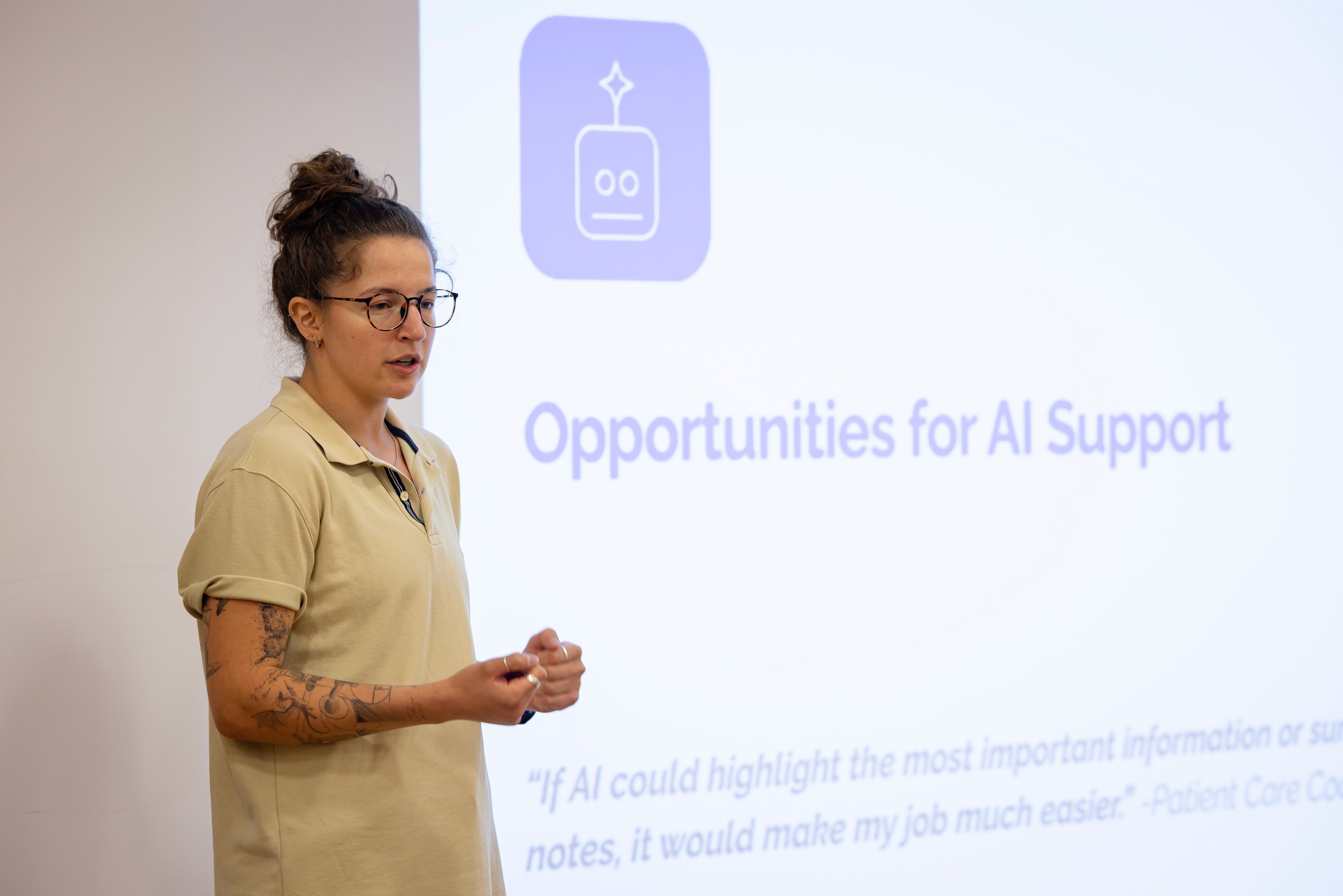
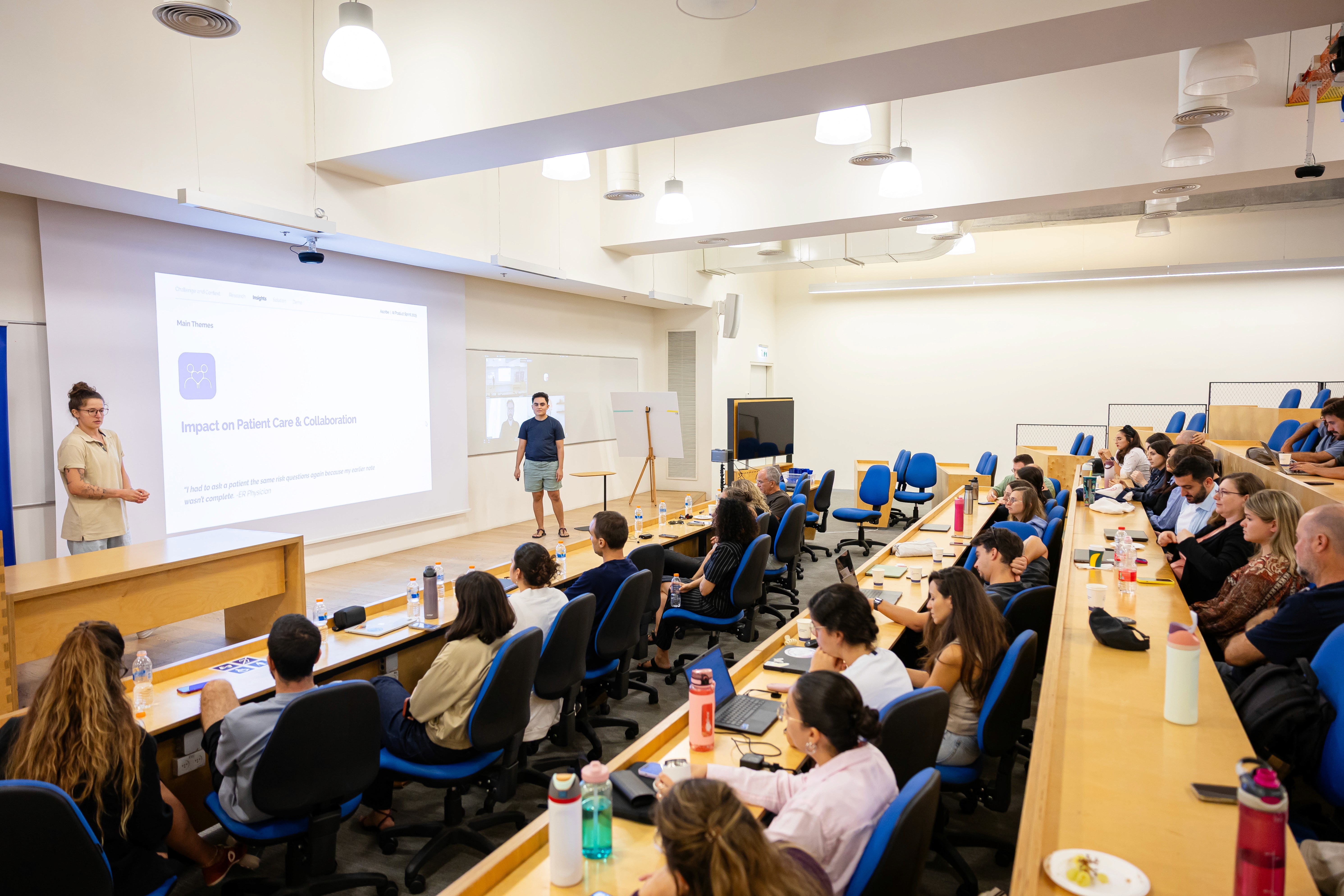
I presented our end-to-end process—problem, insights, concept, and prototype—to a panel of senior medical professionals, tech founders, and Wix/Base44 leadership. My pitch communicated the urgency of the problem, the rationale behind our solution, and the real-world impact of Ascribe. The clarity of the presentation contributed to our project being selected as the competition winner.
Industry Validation
After winning the sprint, our team was flown to the Wix NYC office to continue developing Ascribe. I helped conduct usability testing sessions and synthesized clinician feedback. Our prototype was validated as accurate in extracting information from photos, handwriting, and dictation, and clinicians emphasized its potential to significantly reduce documentation burden.

